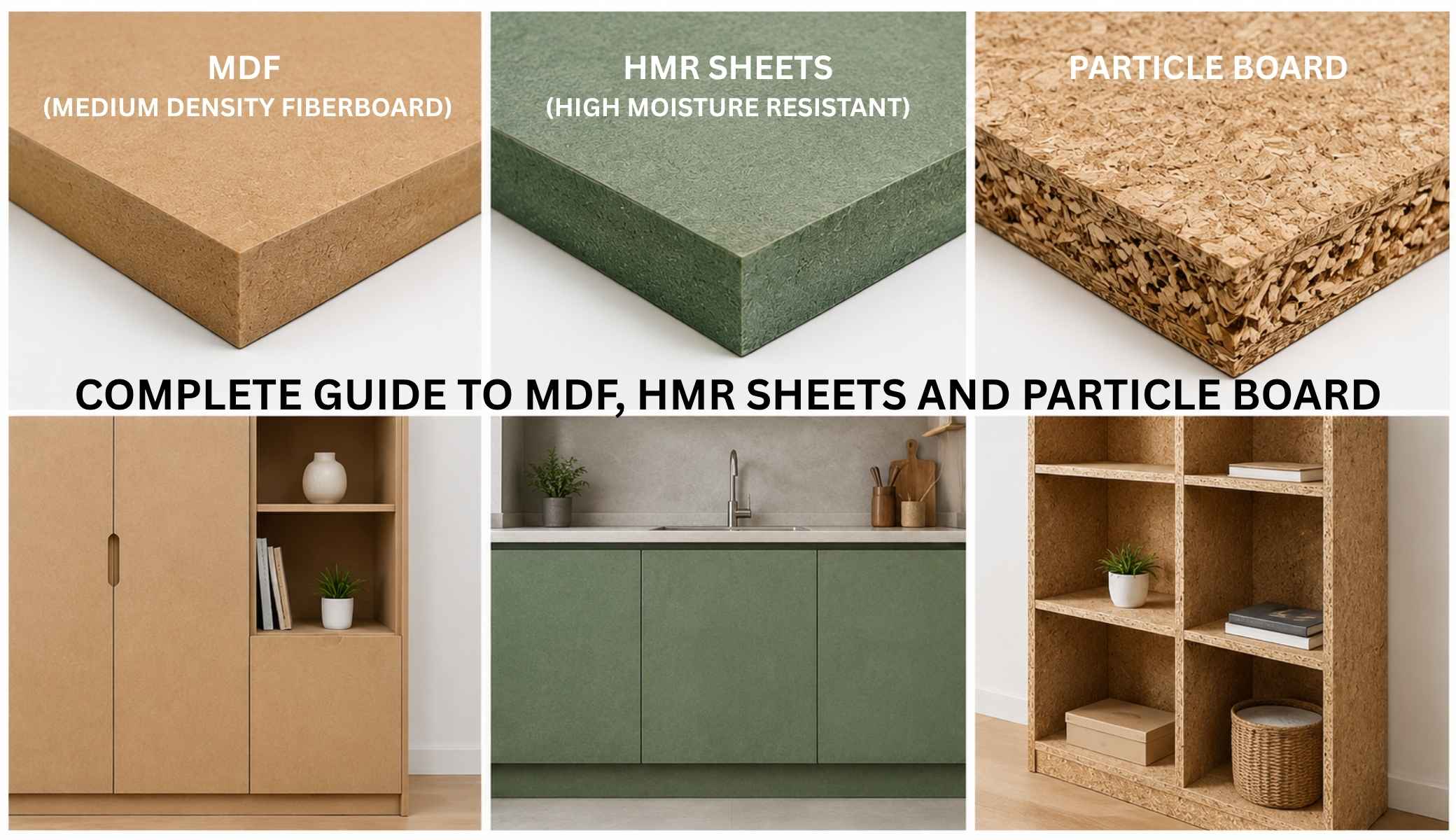
Difference Between MDF, HMR Sheets and Particle Board
Home |
Blogs | Difference Between MDF, HMR Sheets and Particle Boards
13
MAY
📅 13 05 2026
Difference Between MDF, HMR Sheets and Particle Board
When it comes to interior furniture, modular kitchens, wardrobes, office furniture, and decorative panels, choosing the right engineered wood material is extremely important. Many homeowners, carpenters, interior designers, and furniture manufacturers often get confused between MDF, HMR sheets, and Particle Board because all three materials are widely used in modern furniture manufacturing.
Although these materials may look similar from the outside, they differ greatly in terms of strength, durability, moisture resistance, finish quality, cost, and applications. Understanding these differences can help you select the right material for your furniture project and avoid unnecessary maintenance expenses in the future.
What is MDF?
Medium Density Fibreboard, commonly known as MDF, is an engineered wood product made from fine wood fibers mixed with resin and compressed under high pressure and temperature.
MDF has a smooth and uniform surface, making it one of the most preferred materials for decorative furniture and painted finishes.
Features of MDF
Smooth surface finish
Uniform density throughout the board
Easy to cut and shape
Ideal for painting and laminates
Available in multiple thicknesses
Economical compared to plywood
Advantages of MDF
1. Excellent Surface Finish
MDF provides a very smooth surface, which makes it perfect for paint, veneer, acrylic, and laminate applications.
2. Easy Machining
Carpenters can easily cut, route, and design MDF boards for decorative furniture and CNC patterns.
3. Cost Effective
Compared to premium plywood materials, MDF is relatively affordable.
4. Suitable for Decorative Furniture
It is widely used in TV units, wardrobes, wall panels, display units, and office furniture.
Common Applications of MDF
Decorative wall panels
Modular furniture
Office tables
TV units
Wardrobes
CNC designs
Painted furniture
What are HMR Sheets?
HMR Board stands for High Moisture Resistant board. It is an advanced version of MDF designed to withstand humidity and moisture better than regular MDF boards.
HMR sheets are manufactured using specially treated wood fibers, moisture-resistant resin, and advanced pressing technology. These sheets are commonly green in color to identify their moisture-resistant properties.
Features of HMR Sheets
Better moisture resistance
Stronger than MDF
Smooth surface finish
Good screw holding capacity
Durable and stable
Suitable for humid environments
Advantages of HMR Sheets
1. Moisture Resistance
HMR sheets are specially designed to resist moisture, making them suitable for kitchens and semi-wet areas.
2. Better Strength
Compared to standard MDF, HMR boards are denser and stronger.
3. Excellent Finish Quality
HMR sheets support laminates, acrylic finishes, PU paint, and veneers very well.
4. Longer Life
Due to better durability and resistance properties, HMR furniture generally lasts longer.
Common Applications of HMR Sheets
Modular kitchens
Bathroom vanities
Wardrobes
Premium furniture
Interior wall panels
Moisture-prone areas
What is a Particle Board?
Particle Board is made using wood chips, sawdust, and resin compressed into sheet form under heat and pressure.
Particle board is one of the most economical engineered wood products used in furniture manufacturing.
Features of Particle Board
Lightweight
Budget-friendly
Available in pre-laminated finishes
Smooth surface
Easy to install
Advantages of Particle Board
1. Affordable Price
Particle board is one of the cheapest materials used in furniture making.
2. Lightweight
It is easier to transport and handle compared to MDF and HMR sheets.
3. Suitable for Modular Furniture
Pre-laminated particle boards are commonly used in ready-made furniture.
4. Eco-Friendly Usage
It utilizes wood waste and recycled wood particles.
Common Applications of Particle Board
Budget furniture
Office partitions
Ready-made wardrobes
Temporary furniture
Study tables
Storage units
MDF vs HMR Sheets vs Particle Board
1. Strength Comparison
HMR sheets are the strongest among the three.
MDF provides moderate strength.
Particle boards have the lowest strength.
2. Moisture Resistance
HMR sheets offer excellent moisture resistance.
MDF has limited resistance to moisture.
Particle boards perform poorly in humid conditions.
3. Surface Finish
MDF and HMR sheets provide superior smoothness.
Particle board finish quality is comparatively lower.
4. Durability
HMR sheets are highly durable.
MDF offers decent durability in dry areas.
Particle boards have a shorter lifespan.
5. Cost Comparison
Particle boards are the cheapest.
MDF falls in the mid-range category.
HMR sheets are relatively premium priced.
6. Weight
HMR and MDF are heavier.
The particle board is lightweight.
7. Best Usage Areas
Material
Best Use
MDF
Decorative interiors
HMR Sheets
Kitchens & moisture-prone furniture
Particle Board
Budget furniture
Which Material is Best for Furniture?
The best material depends on your budget, application, and durability expectations.
Choose MDF If:
You need smooth painted furniture
You want decorative CNC designs
The area is dry and moisture-free
Choose HMR Sheets If:
You need durable modular kitchens
Furniture is exposed to humidity
You want premium-quality furniture
Choose Particle Board If:
You need budget-friendly furniture
Furniture usage is temporary
Lightweight material is preferred
Conclusion
MDF, HMR sheets, and Particle Board each have their own advantages and limitations. MDF is ideal for decorative and painted furniture, HMR sheets are perfect for moisture-resistant premium interiors, and Particle Board works well for budget-friendly furniture solutions.
Before selecting any material, consider factors such as durability, water resistance, budget, furniture usage, and expected lifespan. Investing in the right engineered wood product can significantly improve the appearance, strength, and longevity of your furniture.
If you are designing modular interiors, wardrobes, kitchens, or office furniture, understanding the difference between MDF, HMR sheets, and Particle Board will help you make a smarter and more cost-effective decision.
FAQs
1. Which is better: MDF or HMR sheets?
HMR sheets are better in terms of moisture resistance, durability, and strength. MDF is suitable for decorative indoor furniture in dry areas.
2. Is Particle Board good for wardrobes?
Particle board can be used for budget wardrobes, but it is less durable compared to MDF and HMR sheets.
3. Are HMR sheets waterproof?
No, HMR sheets are moisture resistant but not completely waterproof.
4. Which board is best for modular kitchens?
HMR sheets are considered one of the best choices for modular kitchens because of their moisture resistance and durability.
5. Is MDF stronger than Particle Board?
Yes, MDF is generally stronger and denser than Particle Board.
6. Which material is cheapest?
Particle Board is the most economical option among MDF, HMR sheets, and plywood alternatives.
7. Can MDF be used in bathrooms?
Regular MDF is not recommended for bathrooms because moisture can damage it.
8. What is the lifespan of HMR sheets?
With proper maintenance and edge sealing, HMR furniture can last many years.
9. Which board gives the best finish?
MDF and HMR sheets provide smoother and better finishing quality compared to Particle Board.
10. Is a particle board suitable for heavy furniture?
Particle board is not ideal for heavy-load furniture because it has lower strength and screw holding capacity.